Critical supplier identification is widely misunderstood across global supply chains, where size is often confused with operational dependency. Most organizations have thousands of suppliers. Yet identifying which ones pose genuine operational, financial, or sustainability risks—and which ones require active engagement and monitoring—is fundamentally misunderstood.
A critical supplier is one whose disruption, failure, or non-performance would materially impact your business continuity, financial results, regulatory compliance, or strategic objectives. A big supplier, measured by spend, might pose no operational risk at all if viable alternatives exist.
This distinction changes everything about how you approach supplier engagement, data collection, and sustainability reporting.
An organization might spend far more with a large supplier than a smaller one, yet the smaller supplier could be far more critical to operations. Consider a scenario where:
This is not negligence. It is triage. Resources applied uniformly across all suppliers yield diminishing returns. Focus applied to the genuinely critical ones yields disproportionate risk reduction.
The question practitioners face is: On what basis are you identifying the critical few? And equally important: What do you do about the rest?
Criticality is determined by multiple, overlapping factors. No single metric—not spend, not supplier size, not industry—defines it alone.
The foundational question: if this supplier stopped providing what you need, could your operations continue?
Financial viability matters here. Is the supplier at risk of going out of business? In some cases, smaller suppliers carry higher financial instability risk than larger, well-capitalized ones. A supplier that cannot access capital or operates on thin margins is a critical supplier worth monitoring, despite lower absolute spend.
Can you easily switch to another supplier if needed?
This is perhaps the most practical measure of criticality. Even a large supplier becomes critical when:
These switching barriers make supplier transition slow and costly, regardless of how large the primary supplier is. A small, specialized supplier serving a niche segment might have higher criticality than a commodity provider, precisely because alternatives are scarce.
Some suppliers own IP or proprietary processes that cannot be easily replicated or sourced elsewhere.
Examples include:
When a supplier owns essential IP, they become structurally critical. Replacing them requires either acquiring the IP, waiting out patent periods, or accepting inferior alternatives.
Some suppliers are inherently riskier based on their operating location or regulatory environment.
A supplier operating in a region subject to trade restrictions, sanctions, political instability, or supply chain vulnerabilities carries elevated criticality. This is not speculation; it is practical risk assessment. Geopolitical events can disrupt supply at short notice, making geographic diversification—and therefore supplier criticality assessment—a legitimate business concern.
Similarly, suppliers in jurisdictions with weak regulatory oversight or enforcement may pose compliance risks that larger suppliers in stable markets do not.
Different industries define supplier criticality through different lenses.
For organizations focused on data security or digital supply chains: cybersecurity becomes a dominant criticality parameter. A software or technology supplier’s security posture determines whether they are critical regardless of their size or spend.
For organizations in food service or hospitality: supplier criticality often hinges on food safety, traceability, and the ability to meet stringent quality and health standards. A small supplier that provides a unique raw material or serves regulatory requirements becomes critical. Similarly, a supplier that sources raw materials in high-risk geographies or that must comply with local health and safety regulations becomes critical based on sustainability and quality performance, not spend.
For organizations managing environmental impact or pursuing sustainability targets: supplier criticality is often determined by their environmental footprint, materials sourcing practices, and emissions. A supplier with high material intensity, significant raw material sourcing, or non-compliance with local environmental regulations may be critical to sustainability performance, even if they represent a small share of spend.
In some cases, criticality is determined by what the supplier provides, not by its size or market position.
Materials that are:
These materials make their suppliers critical, regardless of the supplier’s own scale or financial health.
Organizations often approach supplier criticality through two different lenses, and understanding which one you are using is essential.
Risk-driven approaches prioritize suppliers based on operational, financial, or geopolitical risk factors. The goal is business continuity. Which suppliers, if disrupted, would create the most damage?
Reporting-driven approaches prioritize suppliers based on regulatory requirements or voluntary sustainability commitments. The goal is compliance and disclosure. Which suppliers must be monitored to meet environmental or social reporting standards?
These are not mutually exclusive, but they often prioritize different suppliers. A supplier might be low-risk from an operational standpoint but high-priority for sustainability reporting if they represent significant emissions in your value chain. Conversely, a geopolitically risky supplier might be operationally critical but low-priority for environmental reporting.
Most organizations are increasingly moving toward risk-driven approaches because they are harder to ignore. Reporting requirements can be deferred or managed incrementally. Operational risk cannot. But the transition is gradual, and many organizations still rely primarily on reporting-driven logic.
Identifying critical suppliers is one task. Collecting sustainability, risk, or compliance data from them is another—and significantly harder.
Even when a supplier is willing to provide information, they often cannot do so efficiently. This is not because they are obstinate; it is because of structural friction in how data flows between organizations.
When a large buyer requests data from a supplier, the request typically requires specific formatting, metrics, or standards. The supplier may track this information internally but not in the format the buyer has requested.
A practical example:
For a small or mid-sized supplier with limited resources, this translation work is not trivial. They may need to:
What should take hours becomes a multi-week or multi-month project. The cost—whether in time or money—often falls on the supplier, not the buyer.
Large buyers often work with many suppliers. Each supplier may receive requests from multiple customers, each with different formats, standards, and reporting timelines.
A supplier might receive:
Each request is slightly different. Each uses different terminology, different units, different boundaries. The supplier’s small data or compliance team becomes overwhelmed. They must make a decision: respond to requests from the largest or most important customers and deprioritize the rest, or respond to none.
Not responding is a safer choice. There is no penalty for ignoring a questionnaire; there can be penalties for providing incorrect data.
This brings us to a counterintuitive dynamic: large, critical suppliers have more power to decline data requests than small ones.
Consider a scenario where:
In this case, a supplier can decline to provide data or ask for additional compensation in exchange for compliance. They can say, “We can provide this, but it will cost you extra,” and many buyers will pay rather than lose the supplier or face disruption.
Conversely, a small supplier who serves a competitive market where substitutes are readily available cannot afford to decline. They have stronger incentive to cooperate.
This creates a practical problem: the suppliers you most need to engage with (critical ones) often have the most leverage to resist engagement. Larger, well-established suppliers may also be subject to their own corporate policies or security restrictions that prevent them from sharing certain data, even if they are willing.
The trend is toward risk-driven approaches. Regulatory requirements are evolving to demand more transparency on supply chain risks, not just environmental metrics. Geopolitical volatility is making supply chain resilience a board-level concern. Financial performance increasingly depends on avoiding supply chain disruptions.
As a result, many organizations are moving away from spend-based supplier prioritization toward risk-based criticality frameworks. But this transition requires time. Teams must align. Methodologies must be defined. Suppliers must be educated about why they are being asked for data.
The organizations that invest in this transition early will have more resilient supply chains, better data for decision-making, and clearer insights into where their real dependencies lie.
For the rest, supplier criticality remains poorly understood, and the vast majority of supplier base remains unmapped and unmonitored—often for good reason, but sometimes at hidden cost.
The shift to risk-based criticality is not just strategic—it requires operational capability. Organizations executing this transition successfully combine three elements:
When these elements work together, critical supplier identification becomes defensible and sustainable. Procurement teams reduce supplier engagement burden by 60–70%, risk leaders operationalize insights instead of maintaining static registers, and sustainability teams cut Scope 3 mapping cycles from months to weeks.
The alternative—continuing with spend-based prioritization, questionnaire fatigue, and fragmented data sources—carries hidden costs: missed dependencies, delayed decisions, audit exposure, and supplier relationships strained by misaligned requests. The choice between these paths determines whether your organization gains clarity and resilience or continues to confuse size with criticality.
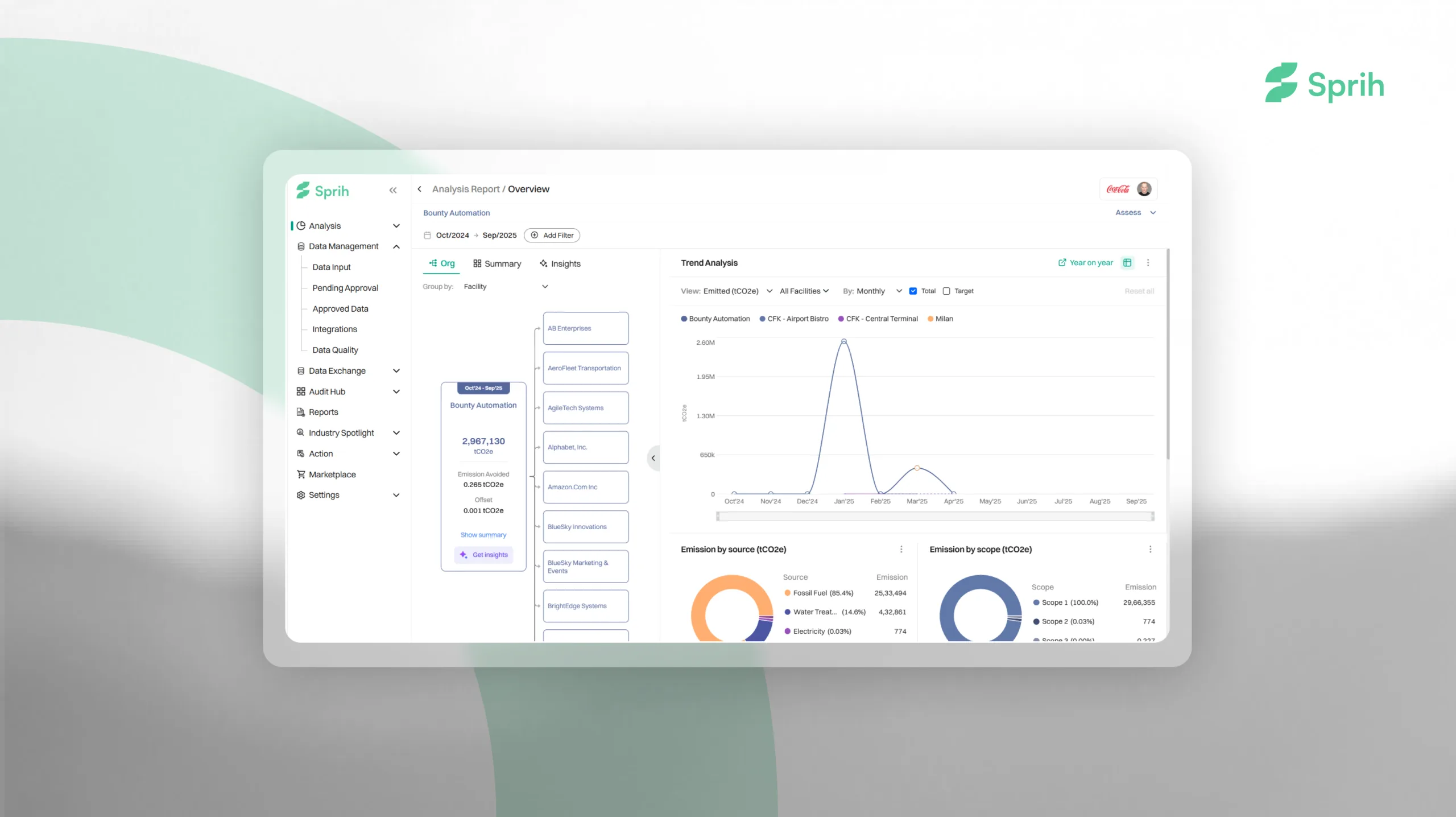
If your organization is rethinking how it defines and manages critical suppliers, Sprih can help you operationalize that shift. Sprih’s AI native supply chain sustainability platform is built to support multi-factor criticality frameworks, streamline supplier data collection without forcing manual reformatting, and integrate intelligence to reduce questionnaire fatigue.
The result is clearer visibility into real dependencies, faster risk assessment cycles, and more reliable Scope 3 and compliance reporting. If you are ready to move beyond spend-based prioritization and build a defensible, risk-driven supplier strategy, connect with Sprih to see how the approach can work in your supply chain.